Instant Form CPL dropped forty percent in a week. Marketing Slack lit up. By Friday, sales had worked twenty-two leads and booked one meeting with someone who thought the company sold consumer software.
The form was fine. The offer was fine. The format had done its job: it made submitting almost effortless. That was the problem.
This is for B2B teams running Meta or Facebook Ads who are stuck between keep them on-platform and send them to a page. If sales complains that Instant Form leads never book, or if site traffic converts slowly but quality is better, you need an explicit decision. Preference for whichever Ads Manager report looks greener is not a framework.
Meta Instant Forms are easy to launch. B2B sales follow-up is not. The format you choose should protect lead quality and meeting rate, not just produce a CPL screenshot that collapses under pipeline review.
Friction buys volume. Context buys seriousness
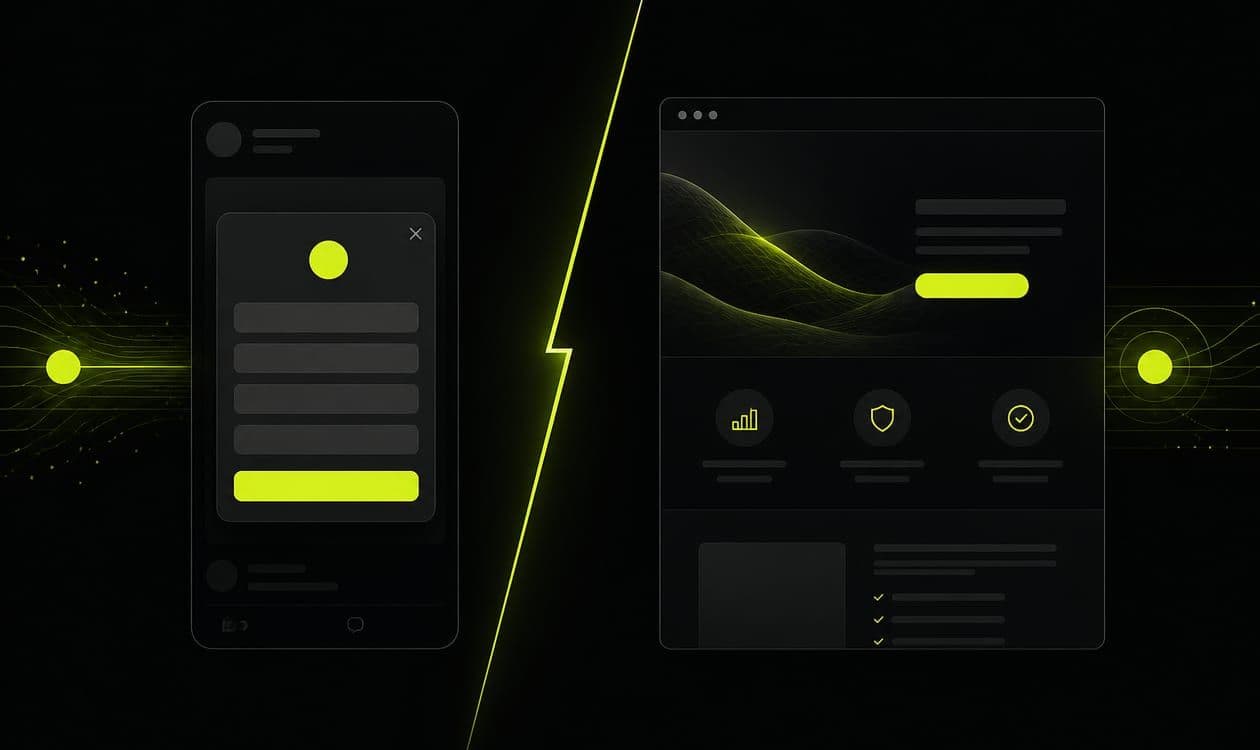
Instant Forms reduce friction. Someone can submit without leaving Facebook or Instagram. That speed can raise volume and lower reported CPL. It can also attract people who would never have finished a longer site flow, including tire-kickers, students, and curious scrollers.
A dedicated landing page adds friction and context. Proof, positioning, and richer fields can filter for seriousness. Tracking and CRM context are usually cleaner. Cold traffic that needs a story often converts better when the page continues the ad promise instead of dumping them into a short on-platform form.
Neither format is morally superior. Each trains Meta's delivery toward whatever you optimize for. If you optimize for form completes and celebrate cheap leads sales will not take, the algorithm did its job. Your system failed.
Say the tradeoff out loud in planning. We are buying speed. Or we are buying context. Teams that pretend they can have maximum speed and maximum qualification without design usually get neither in a usable form.
When Instant Forms earn their keep
Lead forms fit when the offer is simple and the next step is light. A short guide. A teardown request. A diagnostic call with clear expectations. A low-commitment lead magnet that your team can qualify quickly.
They also fit when speed of capture matters more than deep on-page education, and when your ops can follow up within hours, not days. Instant Form leads go cold fast. If your CRM routing is slow, you are buying volume you cannot work.
Use Instant Forms when:
- The offer is clear in the ad and does not need a long proof narrative
- Qualification can happen in the form fields or immediately after via enrichment or SDR
- Your team can respond same-day with a booking path
- You are testing demand creation and need faster learning cycles on creative
Even then, treat Instant Form completes as upstream. The scoreboard remains qualified conversations. The same standard we use across Meta Ads for B2B.
When the page should carry the click
Send traffic to a site funnel when the offer is complex, the buyer needs proof before trusting a form, or sales needs richer context before engaging. Multi-step qualification, calendar booking, and clearer tracking usually live more comfortably on a page you control.
Dedicated B2B landing pages and funnels keep message match from ad to CTA. That continuity matters more on Meta than teams admit. The scroll-stopper promised a specific problem. The page should open on that problem, not a generic brand story.
Prefer a landing page when cold traffic needs education before converting, when you need CRM fields or booking embeds that Instant Forms fight, or when deal size justifies fewer, better-prepared conversations. Sales feedback that Instant Form leads consistently fail to book is usually enough evidence on its own.
A weak page is not an argument for Instant Forms. It is an argument for fixing the page, or for a lighter offer that Instant Forms can carry honestly. From what I've seen, teams flip to Instant Forms to escape a broken funnel, then wonder why meeting rates got worse.
Hybrids, ops, and the scoreboard that actually matters
You do not have to pick one format forever. Instant Forms can carry lighter top-of-funnel offers while you retarget engagers to a booking page. High-intent audiences can go straight to a site funnel with calendar. Capture on Instant Form, then nudge same-day to book on a short page.
Retargeting discipline matters here. People who submitted a form should not keep seeing the same lead magnet. Sequence them toward a conversation. See retargeting without annoying buyers.
Hybrids fail when reporting collapses everything into one CPL. Keep offer paths separable so you can kill the junk magnet without pausing the booking path.
Ask for what you need to qualify, or enrich after capture before routing. A work email alone is not a B2B lead definition. For Instant Forms, keep questions readable on mobile and map every field into the CRM with source and campaign context. For pages, instrument submit and booking as distinct events.
Follow-up SLA is part of the creative system. The best Meta hook cannot save a lead that sits unassigned until Friday. If routing is broken, fix ops before you scale either format. Automation can help when the path is mapped. See GTM automation when manual handoffs lag.
Compare Instant Forms and site funnels on held meetings with ICP fit, opportunity rate, and sales feedback, not only CPL. A format with a higher CPL and stronger conversation rate often wins on cost per qualified conversation. That math is covered in cost per qualified conversation on Meta.
Creative still matters either way. Weak hooks send junk into both Instant Forms and landing pages. Pair format choice with a weekly testing cadence. See the creative testing system for B2B Meta Ads.
One messy observation: I've watched Instant Forms win on conversation rate for a narrowly framed teardown offer, then lose badly when the same team reused the format for a vague demo request. The format was not the variable. The seriousness of the ask was. Format debates that ignore offer depth tend to go in circles.
On a strategy call we pressure-test offer complexity, sales follow-up capacity, tracking maturity, and whether cold traffic needs a story. Then we pick Instant Forms, a site funnel, or a hybrid, and we scoreboard meetings, not vanity completes.
Bring your current form fields, average time-to-first-touch, and a week of sales disqualification notes. Those three inputs usually decide the format faster than another Ads Manager debate.
If you are unsure which path fits your offer, book a free strategy call. We will map it inside Meta & Facebook Ads for B2B and, when a page is the right destination, landing pages and funnels.