B2B teams stretch cold email sequences because silence feels unfinished. Buyers feel stalked. Domains absorb more risk. The offer still was not clear by touch three.
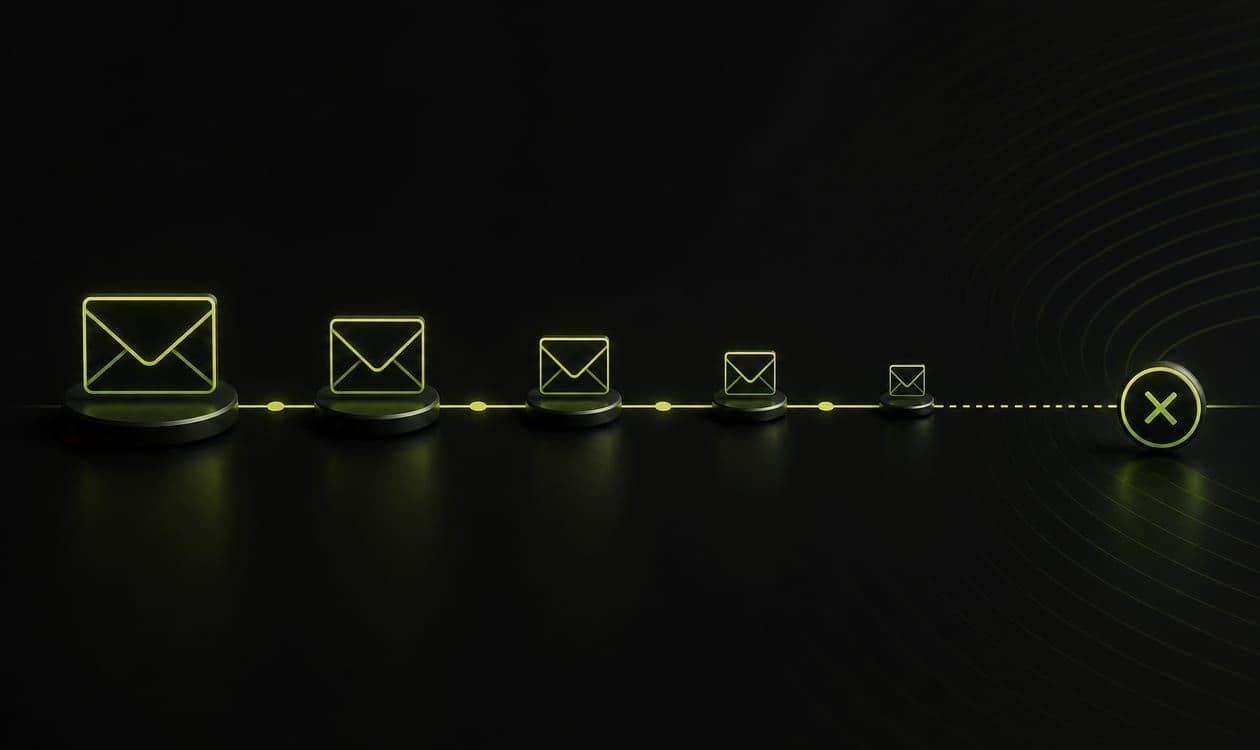
There is no magic number of touches. There is a point where another bump-in email is brand damage with a send receipt. Touches that only say “just bumping this” train people to mute your From name. If your sequence is long because targeting is weak, shorten the sequence and fix the ICP. Do not add persistence as a substitute for relevance.
This is for B2B founders, SDRs, and demand gen leads designing cold email cadences who need a stop rule as much as a start rule. If your sequence is long because targeting is weak, shorten the sequence and fix the ICP. Do not add persistence as a substitute for relevance.
Default shorter than your ego wants
Most B2B sequences earn their decision in a handful of well-spaced touches with distinct jobs. If the offer is unclear by the early touches, later touches will not save it. They will only repeat the confusion with “just following up” energy.
Shorter is not lazy. Shorter forces clarity: one offer, one CTA, touches that add a reason. Longer without new information is how you train buyers to ignore your From name. Build structure first. See sequence structure that books meetings. Then decide length from jobs, not from a template someone copied from a thread.
Write the touch jobs on a whiteboard before you open the sequencer:
- What does touch one earn?
- What new reason does touch two add?
- What does the last touch do: breakup, alternate path, or clean close?
If you cannot name the job, delete the touch. If two touches share the same job, merge them. Length should fall out of jobs and spacing, not from “industry standard is eight.”
Stop when the signal is clear
Hard no, unsubscribe, or sustained silence after a complete sequence means stop. Moving them to a long-term nurture is optional. Stalking is not. Respect is a deliverability feature and a brand feature.
Clear yes: stop sequencing and switch to human reply handling. See the playbook from positive reply to booked call. Do not keep the sequencer firing while a live thread exists.
Soft maybes (“not now,” “send something”) get a defined path and an exit, not an infinite drip that pretends every polite reply is a green light for six more emails.
A breakup email is a clean close, not a guilt trip. Permission to end the thread, a last clear offer, or an invitation to reply with “timing” or “not a fit” can earn polite closures and occasional yeses. Desperation (“I’ve emailed six times…”) trains people to mute you.
If you use a breakup, mean it. Stopping afterward is what makes the breakup honest. Teams that “break up” and then restart three days later teach buyers that your words are noise.
Space for humans, and let offer quality set length
Daily bumps look automated and feel rude. Give buyers room to reply. A sequence that fires every day optimizes for your anxiety, not their calendar. Spacing also reduces the chance that a delayed reply collides with another automated bump and creates an awkward double-thread.
Protect domain health with volume caps. List and infra discipline still matters. Longer sequences multiply sends per contact. If list quality is shaky, length multiplies damage.
Strong ICP plus a clear CTA needs fewer touches. Weak targeting tries to compensate with persistence. Fix targeting first (ICP before volume). Persistence is not a strategy when the wrong people are enrolled.
When offers are high-consideration, you may want one extra touch that adds proof or an alternate angle. Still one destination. That is different from padding. Padding is five emails that could have been two.
Personalization time also interacts with length. Deep research on every contact does not scale across a long multi-touch blast. Prefer segment-level relevance you can sustain. See personalization that scales.
Revisit length by segment. A hot trigger segment may convert early. A colder educational angle may need one more proof touch. One global length for every campaign is usually laziness disguised as process.
After the sequence ends, and how to keep length honest
Options that are not stalking:
- Suppress for a defined period
- Move to a low-frequency nurture with a different job (content, trigger wait) if appropriate
- Re-enter only on a real trigger (role change, new hiring signal, new product need)
- Leave them alone
Re-enrollment without a new reason is how brands become background noise. Triggers restart conversations. Boredom does not.
If you run multi-channel outbound, ending the email sequence should also end conflicting LinkedIn pitches the same week unless the combined motion was designed as one story.
Contacting multiple stakeholders multiplies perceived touch count at the account. Coordinate so the company does not feel sprayed. Account-level caps and shared visibility matter more as deal size grows.
New product lines should not automatically re-open every closed sequence. New reason plus new ICP slice, or wait for a trigger. Otherwise length becomes a forever campaign wearing different subject lines.
Report meetings and opportunities from the sequence, plus unsubscribe and complaint signals. If later touches never produce incremental meetings, cut them. Teams keep long tails because “someone might reply.” Measure whether they do. Hope is not a touch job.
Long sequences that generate late soft replies can overwhelm a small team if early touches already fill the calendar. Design length for the operating system you have. It is better to run a sharp three-touch campaign you can handle than a seven-touch machine that creates delayed, low-quality threads nobody owns.
When you add inboxes and volume, revisit length. More top-of-funnel without more reply capacity recreates the ignore problem at larger scale.
One messy observation: I’ve seen a four-touch sequence outperform a tighter three-touch on the same offer because touch four was a real alternate proof angle, not a bump. I’ve also seen seven-touch cadences where almost every meeting came from touches one and two, and the tail was mostly reputation risk. Evidence by touch number settles it better than tradition. I won’t pretend there’s a universal “right” length.
Quarterly, look at where meetings come from by touch number. If almost all meetings come from touches one and two, your long tail is mostly cost and reputation risk. If a late proof touch consistently converts a segment, keep it for that segment only.
Share the stop rule with leadership so “just add two more follow-ups” is not a casual request that undoes deliverability discipline. Length is a strategy decision with domain consequences.
We design cold email sequences with an exit, not infinite follow-ups. Book a free strategy call if your cadence is long and your meetings are not. Bring your touch plan, spacing, and where replies actually occur in the sequence.
We’ll help you cut the touches that only exist to soothe anxiety, and keep the ones that earn a decision.