Where does a lead go when the CRM write fails and Slack stays quiet?
A form can fire at 9:41am, hit a renamed required field, and leave sales discovering the miss three days later when the prospect emails “did you get my request?” That lead still shows as a mystery in someone’s head. It was a missing failure path.
The most expensive automation bug is the quiet one: a lead submits, the workflow fails, nobody is notified, and sales never knows the opportunity existed. Happy-path demos look sharp in a Loom. Production GTM automation assumes APIs rate-limit, fields change, and OAuth expires, then designs for it.
Assume failure is normal
Design retries, dead-letter paths, and human alerts, not happy-path-only demos. Treat lead workflows like production infrastructure: named owners, observability, and a pause or replay rule when health degrades.
Failure modes to plan for:
- Rate limits and transient 5xx responses
- Auth token expiry and revoked connections
- CRM validation errors from required fields or picklist changes
- Duplicate detection conflicts
- Payload shape changes after a form “improvement”
- Partial success: CRM created and Slack failed, or the reverse
If your workflow cannot describe what happens in each case, it is not ready for paid volume from Google Ads or Meta.
From what I’ve seen, teams that treat failure as an edge case discover it as a pipeline week.
Alert where humans already look, and keep retries safe
Slack, email, or a triage channel with payload context: which lead, which step, what error. A red badge in an unused admin UI is not an alert.
Useful alert content:
- Lead email or company, or anonymized ID if policy requires
- Workflow name and failed node
- Error message excerpt
- Link to execution log
- Suggested next action: retry, fix field, check auth
Noise kills alerting. Separate needs-human-today from informational logs. If sales and ops mute the channel, you are back to silent drops.
Retries should not create three CRM records for one form fill. Upsert by email or external ID. Document the key. The same discipline as solid n8n lead routing.
Idempotency also applies to Slack and offline conversion pushes. Replaying a failed run should not spam the channel or double-upload conversions. Store a processed marker or use platform dedupe keys where available.
Partial success needs explicit design. If CRM write succeeds and Slack fails, retry Slack only. If Slack succeeds and CRM fails, do not create a second Slack storm on replay without fixing CRM first, or use a hold queue until both sides settle.
Runbooks, queues, and observability that survive a bad week
Write who fixes what. If only one contractor can revive the flow, you do not have automation. You have a single point of failure.
Runbook minimum:
- System map: triggers, destinations, credentials
- How to locate a lost lead by email or execution ID
- How to replay safely
- Who has admin access, primary and backup
- When to pause paid or forms if routing is down
Test the runbook once. A document nobody has used is fiction.
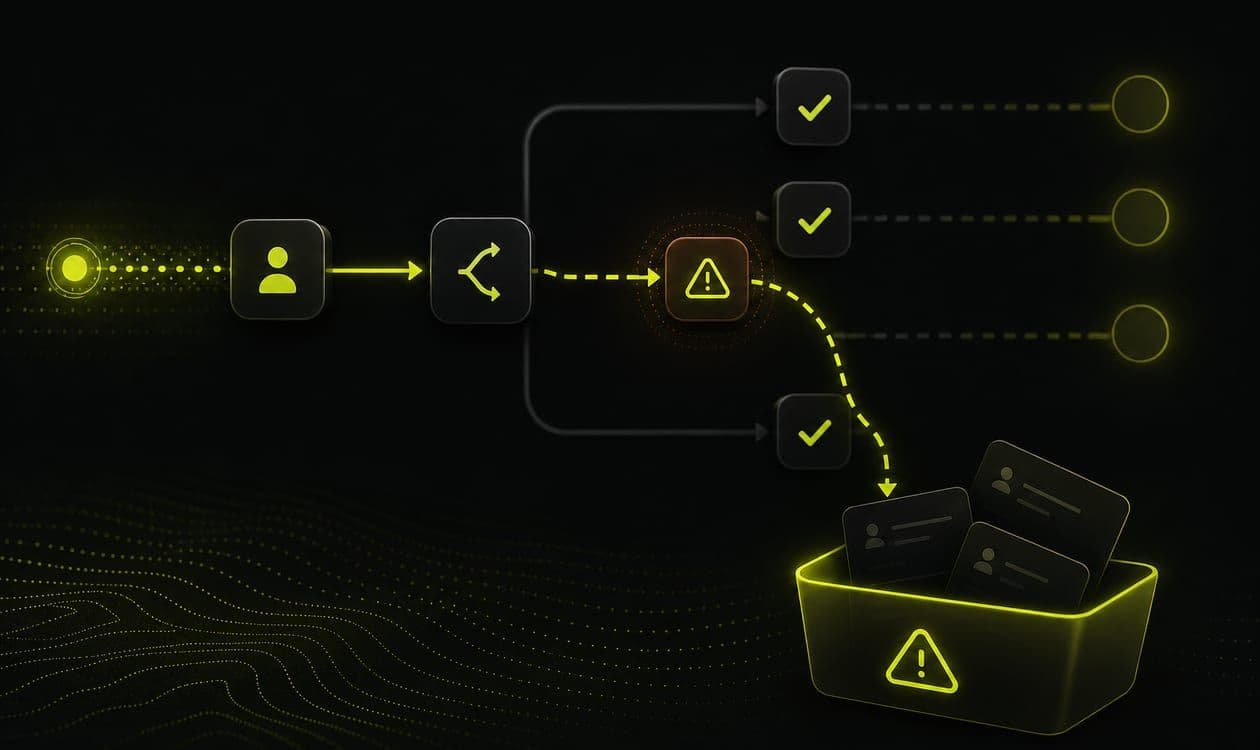
Retry transient errors with backoff. Do not retry validation errors forever. Send those to a dead-letter path with a human alert. Poison payloads should not block the whole queue.
A simple pattern that works for many B2B stacks: attempt happy path, retry transient failures a few times, park poison messages with alert, then review parked items weekly until empty. Queues without owners become graveyards.
Log enough to reconstruct a lead’s path without dumping PII into places it should not live. Retain execution history long enough to investigate a sales complaint from last week.
Reconcile weekly during the first month after launch: form submits vs CRM creates vs Slack alerts. Gaps are bugs. Same operator habit as closing the ads ↔ CRM loop. Silent gaps are unacceptable.
Tool choice does not replace failure design
Zapier and n8n both fail. Managed vs self-hosted changes where you look for logs, not whether you need alerts and runbooks. See Zapier vs n8n for GTM ops. Pick the tool you will actually observe.
Enrichment and offline syncs deserve the same bar. A vendor timeout should not strand a hot lead without a route-first fallback. See when to automate lead enrichment.
Teams that punish people for reporting broken zaps learn to hide broken zaps. Celebrate caught failures and fast replays. The enemy is silence, not imperfect software.
Include failure metrics in ops review: alert count, mean time to restore, leads recovered vs lost. If you only report workflows live, you incentivize theater.
Do not scale paid until failure paths exist. Readiness still includes process clarity from when to add automation, plus the humility to assume production breaks.
Staging matters. Maintain a non-production workflow or mode that uses test CRM records and a #ops-alerts-test channel. Prove retries and alerts there before you point production paid traffic at a new version. Untested improvements are a leading cause of silent drops.
Change management belongs next to error handling. When someone renames a CRM property or edits a form field, the workflow owner should know before go-live, not after sales asks where the leads went. A simple changelog in the runbook beats postmortems that start with we thought it was fine.
Define severity. Auth failures and CRM creates failing are Sev-1 for inbound paid. A cosmetic Slack formatting bug is not. Without severity, every alert looks the same and humans learn to ignore all of them.
One messy observation: some of the most reliable stacks I’ve seen still have ugly alerts. Truncated error text. Awkward formatting. But someone reads them the same day. Pretty silent dashboards lose more pipeline than ugly loud ones.
I’m still unsure how elaborate a dead-letter system a five-person GTM team needs on day one. Retries plus a useful Slack alert can be enough early. What I will not soften is the no-alert case. Silence is the expensive mode.
After an incident, write a five-line postmortem: what failed, how many leads were affected, how you recovered, what you changed. Keep it blameless. The goal is a harder-to-break system, not a scapegoat. Share it with whoever owns paid so media does not scale into a known hole.
Before you celebrate a green execution history, run one forced failure in staging and confirm a human gets a useful alert with a safe replay path. Untested happy paths are still silent-drop risks with better screenshots.
We build GTM automation with failure paths on purpose. Book a free strategy call if leads have gone missing somewhere in Zapier. Bring one example timestamp and the tools in the path. We will map where silence lives and how to kill it.