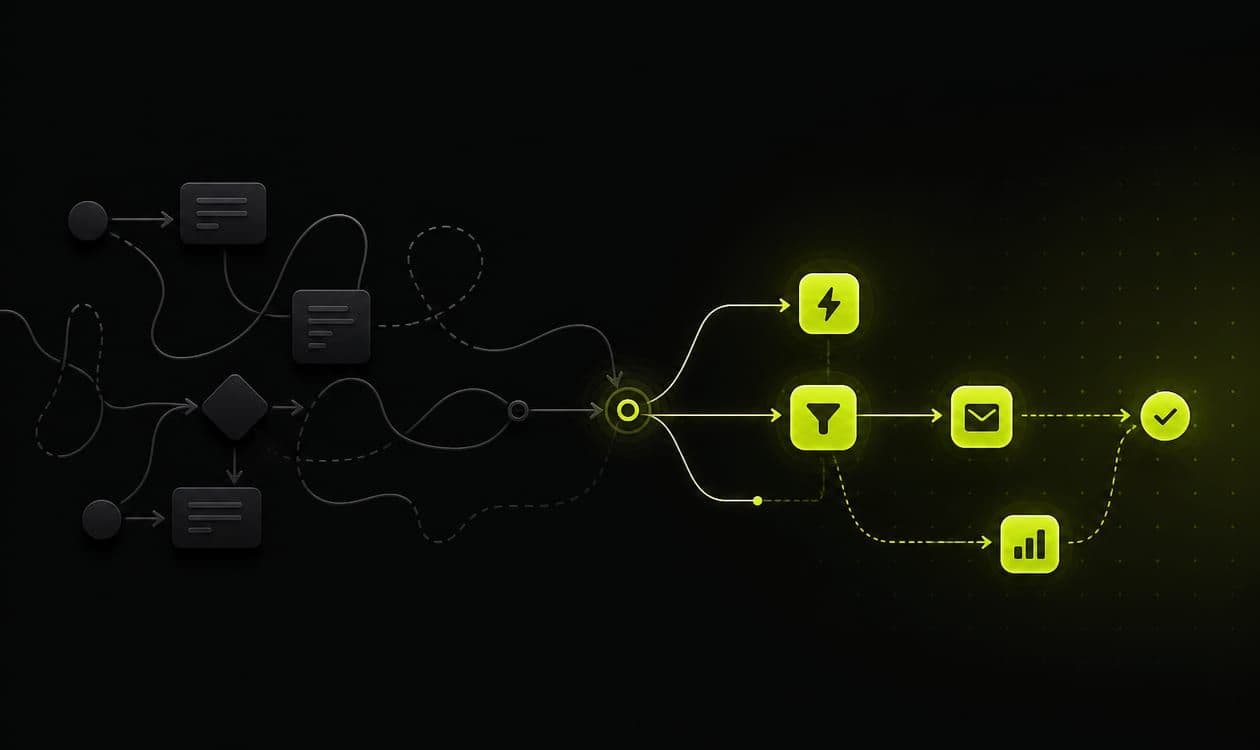
Monday morning. Four CSV exports. A Slack thread titled who owns this??. An Instant Form lead from Friday that still had no CRM owner.
By the time they assigned it, the prospect had already booked a competitor. Nobody could say whether that was a process failure or just a busy weekend. It was both.
Manual lead ops feel fine until paid and outbound start producing real volume. Then leads sit unassigned, SDRs re-type the same fields across tools, and reporting becomes a ritual of exports nobody trusts.
This is for B2B founders, RevOps, and GTM operators running ads, outbound, or both who need named conversations. If your team is arguing about tools before they agree on ownership and qualification, start with readiness. Tool choice can wait.
From what I’ve seen, automation should remove friction between a lead event and a human conversation. It should not become a side project that only one contractor understands.
You’re ready when friction shows up in the same places
Automation has a clearer ROI when two or more of these already hurt:
- Leads sit unassigned for hours while competitors reply in minutes
- SDRs re-enter the same data across CRM, sheets, and Slack
- Reporting needs four CSV exports every Monday
- Outbound replies lack a consistent enrichment or routing path
- Click IDs and UTMs die between the form and the CRM
- Nobody can explain what happens when a workflow fails at 6pm
If none of those hurt yet, you may not have an automation problem. You may have a volume or process problem. Automating chaos just ships chaos faster.
I’ve watched teams buy Zapier seats because a peer’s stack looked neat on LinkedIn. Six weeks later they had twelve zaps and the same unowned Instant Form leads. The tool was never the bottleneck.
Map the path before you open the builder
Write the happy path and the failure path on one page before you open n8n or Zapier. Who owns exceptions? What happens on duplicate leads? Where do errors alert? Which CRM field is the source of truth for owner, stage, and attribution?
A useful map usually includes:
- Trigger: form submit, Instant Form, positive reply, calendar booked
- Create/update rules: email match, company domain, external ID
- Assignment: round-robin, territory, product line, or named AE
- Notification: Slack channel, payload fields sales actually reads
- Failure: retry, dead-letter, human alert, who fixes it
If you cannot whiteboard that without arguing, you are not ready to automate. You are ready to decide. Once the map exists, what to automate first is the next useful question.
Routing, enrichment that changes a decision, reminders, attribution hygiene, and reporting syncs scale well. Empathy, discovery, and judgment do not. Keep humans in the moments that create deals.
Common overreach looks modern: scoring models nobody trusts, auto-sequences that ignore reply context, or AI summaries that replace reading the form. In most teams those lose to a clean owner plus a Slack alert with ICP context.
Prefer workflows you can explain in five minutes. Clever one-offs that only one person understands will fail quietly, and quiet failure is how opportunities vanish. For the flagship pattern, see n8n for B2B lead routing: ads → CRM → Slack.
The unsexy prerequisites that usually decide whether it sticks
Agree on qualification language with sales before you wire tools. If marketing calls something an MQL and sales calls it spam, automation will accelerate the argument.
Agree on ownership SLAs. Speed-to-lead without a named owner is theater. Round-robin without coverage rules creates overnight orphans.
Agree on identity. Persist GCLID, Meta click IDs, and UTMs on lead create. Without them you cannot close the loop later, and paid media keeps optimizing for form fills.
Channels still matter. Automation does not fix weak Google Ads conversion definitions or muddy Meta creative. It moves what those channels produce into human hands faster. Fix offer and destination quality in parallel.
Delay automation when ICP and offer still change weekly with no written baseline, when sales cannot describe a good lead without hedging, when CRM stages are decorative, or when no one will own alerts after launch. In those cases a shared sheet with clear owners beats a fragile workflow.
Tool choice is secondary to failure design
n8n is excellent for GTM workflows that need branching, observability, and cost control at volume. Zapier can be fine for early glue. Custom development fits when you need product-grade reliability or deep integrations.
The agency view on Zapier vs n8n is ownership and failure handling, not brand loyalty. Whatever you pick, design for failure. APIs rate-limit. OAuth expires. Fields rename. See error handling for GTM workflows before you celebrate a happy-path demo.
You are ready to build when happy and failure paths are written, named owners exist, duplicate rules are documented, Slack is where humans already look, attribution fields exist in CRM, and someone will reconcile weekly for the first month.
You are not ready when the brief is “make Zapier do everything we do manually” with no prioritization. That produces brittle theater.
Measure automation by pipeline outcomes, not by number of workflows live. Useful signals: time from lead event to first human touch, percent of leads with an owner inside your SLA, sync failure rate, and whether sales still complains about missing context.
Do not celebrate “we automated enrichment” if sales ignores the fields. Do not celebrate “we closed the loop” if offline conversions never reconcile to CRM opportunities.
One messy observation: some of the best-run lead ops stacks I’ve seen looked almost unfinished on a demo call. Three boring workflows. Clear owners. A weekly reconcile habit. The teams with forty zaps and a beautiful architecture slide were often the ones still losing Friday Instant Form leads.
I’m still unsure how much “AI for lead ops” belongs in the first build. Summaries and draft openers can help after a human owns the record. Putting generative steps in front of routing usually adds failure modes without protecting pipeline.
Lead ops sits between acquisition and sales. Landing pages and funnels must collect what routing needs. Paid and outbound must share qualification language. Measurement must agree on what counts as a real conversation.
Start small: one channel trigger, one CRM upsert, one Slack alert, one failure path. Expand after the first path is observable and owned. Parallel builds across every tool at once is how teams inherit debt nobody can unwind.
Treat the first production workflow as a pilot with a named owner and a weekly reconcile habit. If nobody checks form volume against CRM creates for thirty days, you did not ship automation. You shipped hope with an API key.
Aleksifa builds GTM automation around acquisition systems, ads, outbound, and CRM, so growth does not drown in busywork. If manual lead ops are already costing conversations, book a free strategy call. Bring your current routing map, even a messy one, and where leads go missing today.